





Research
Magnetic Properties of Paramagnetic Heterometallic One-Dimensional Chain Complexes
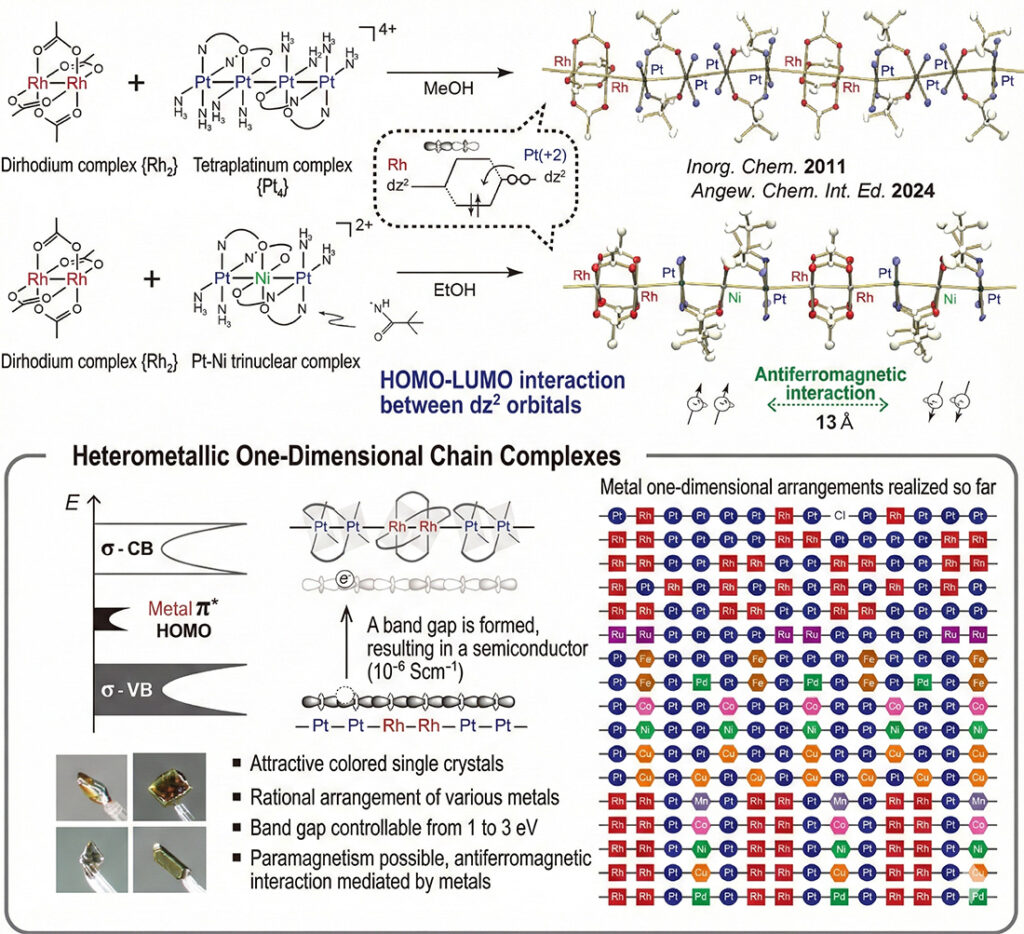
One-dimensional chain complexes that form d-bands and serve as target compounds for electrical and magnetic properties include systems such as KCP, Magnus salts, and halogen-bridged MX and MMX complexes, in which a single type of metal is aligned in a chain. However, one-dimensional chain complexes possessing direct metal–metal bonds are still limited in number. One reason for this is that rational synthetic methods for such complexes have not yet been fully established. In addition, the metals employed in these systems are highly restricted, mainly to platinum (Pt), rhodium (Rh), iridium (Ir), and palladium (Pd).
Under these circumstances, I have succeeded in synthesizing a new type of one-dimensional chain complex composed of multiple kinds of metals by utilizing HOMO–LUMO interactions between two different metal complexes. Our goal is to arrange a variety of metals in a controllable, necklace-like fashion and to realize novel physical properties emerging from these architectures.
Review:
- Bull. Chem. Soc. Jpn, 2025, 98, uoaf101. doi: 10.1093/bulcsj/uoaf101
- Coord. Chem. Rev., 2022, 471, 214736. doi: 10.1016/j.ccr.2022.214736
- Dalton Trans., 2017, 46, 5474-5492. doi 10.1039/C6DT04515D
Mixed-Valence Assemblies of Polyoxometalates and Polynuclear Platinum Complexes
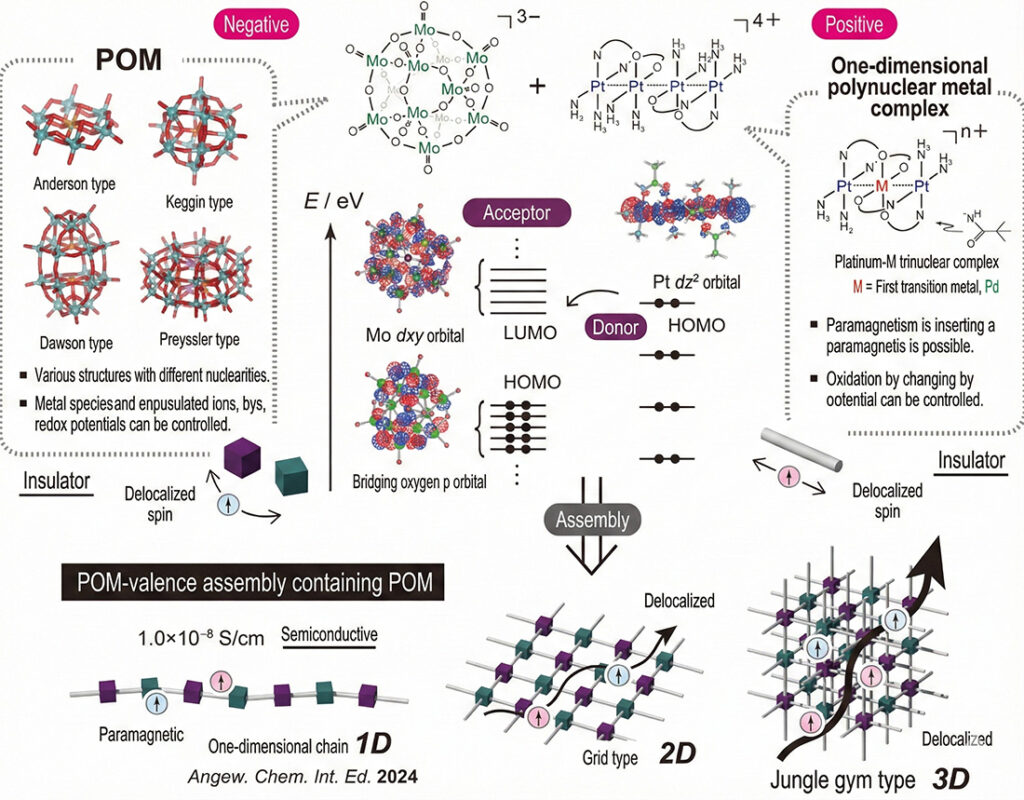
Polyoxometalates (POMs) are spherical anionic polynuclear metal complexes in which high-valent metal centers are linked by oxygen atoms. Various anions can be incorporated into the interior of the sphere, and POMs with diverse characteristics have been synthesized by varying the metal species and the number of metal centers. POMs possess molecular structures that can be regarded as fragments cut from solid oxides; upon one-electron reduction, the unpaired electron becomes delocalized over the spherical framework. However, because the electronic interactions between individual POM units are weak, bulk POM solids generally behave as insulators.
We arrange these POMs in the solid state with well-defined intermolecular interactions and synthesize a variety of molecular conductors composed of anionic POMs and cationic one-dimensional polynuclear metal complexes.
Flexible Porous Coordination Polymers
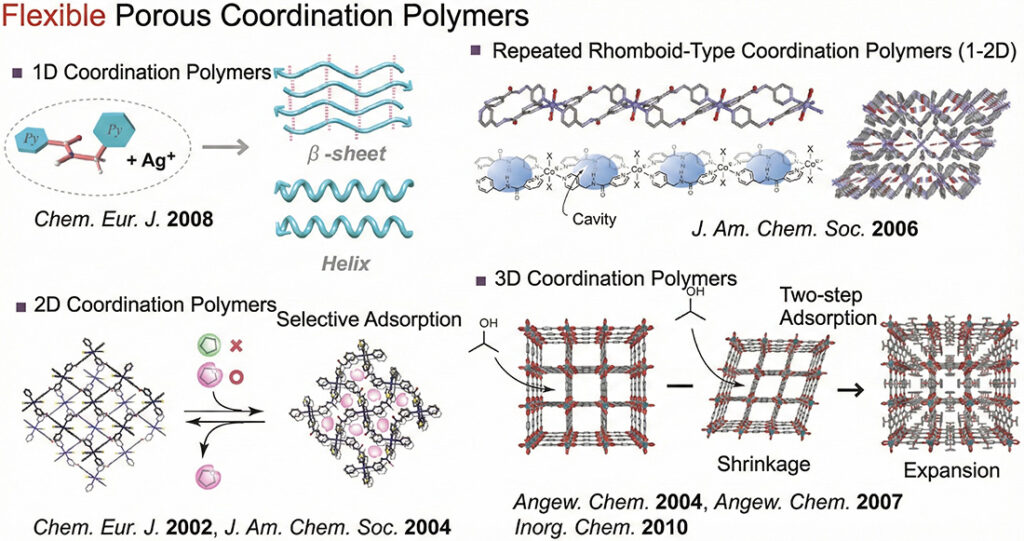
Porous coordination polymers are metal complexes possessing pores, constructed from the coordination geometry of metal centers and designed organic ligands, and are expected to serve as porous materials similar to activated carbon and zeolites. As illustrated in the figure below, networks with a variety of topologies can be formed, and we are pursuing the creation of novel materials while exploring new functionalities of these porous coordination polymers.
Review:
- J. Solid State Chem., 2005, 178, 2420-2429. doi: 10.1016/j.jssc.2005.05.036
- Chem. Soc. Rev., 2005, 34, 109-119. doi: 10.1039/b313997m
